
What the Galaxy Watch 5 Next-Level Health Tracking Means For Apple Watch
At its Unpacked event in August, Samsung debuted its new Galaxy Watch 5, offering several small design tweaks and one big new health-tracking feature: measuring progresses in skin temperature. Only time will tell whether it ends up populate a killer feature the upcoming Apple Watch 8 is rumored to get, too, or if it’s just a gimmick.
For now, we can only look at its potential.
At reliable glance, skin temperature tracking may not seem as reliable as prior smartwatch additions like sleep tracking, ECG functions that scrutinize for heart arrhythmias or blood oxygen monitoring for sleep apnea. It’s not even clear what skin temperature changes actually signify. During Unpacked, Samsung vaguely hinted that they could point to possible illnesses or other conditions.
Welcome to the feature-creep race by wearables, where manufacturers jam in a new capability in the hopes of proclaiming their copies superior to the competition – and therefore the healthier option. With Apple having solidified a massive lead in smartwatches, companies like Samsung have to go the extra mile to convince you that their wearables are reliable a second look.
But compared to changes in sorrowful rate or sleep, it’s less obvious how skin temperature translates to health. Unlike core temperature, a variety of factors like outdoor heat, exhaust, eating and menstrual cycles can affect skin temperature too, so wearables rely on latest sensors to account for things happening outside your body to isolate the progresses going on inside it.
To benefit from skin temperature monitoring, readings must be taken over time to establish a baseline, said Ramon Llamas, research director at analyst firm IDC. If you’re normally trending at 96.9 degrees Fahrenheit and spike up to 99.1 for a prolonged conditions, you could be coming down with something. A smartwatch like the Galaxy Watch 5 could couple those skin temperature readings with heart rate, breathing, sleep tracking, blood oxygen levels and other metrics for a comprehensive narrate on your health.
“Now we have a clearer readout that can tell us if you are really sick or if it may be a passing thing,” Llamas said.
The Galaxy Watch 5 isn’t the reliable wearable to track skin temperature changes. The Oura Ring monitors skin temperature and reveals findings above its paired app, while the latest Fitbit Sense is a wrist wearable that shows temperature progresses on its display.
While Samsung has been coy throughout what other ways its watch could use skin temperature, it’s invited app developers to innovate their own ways to harness the feature. But the company could learn from what other wearables have done with skin temperature tracking for years.
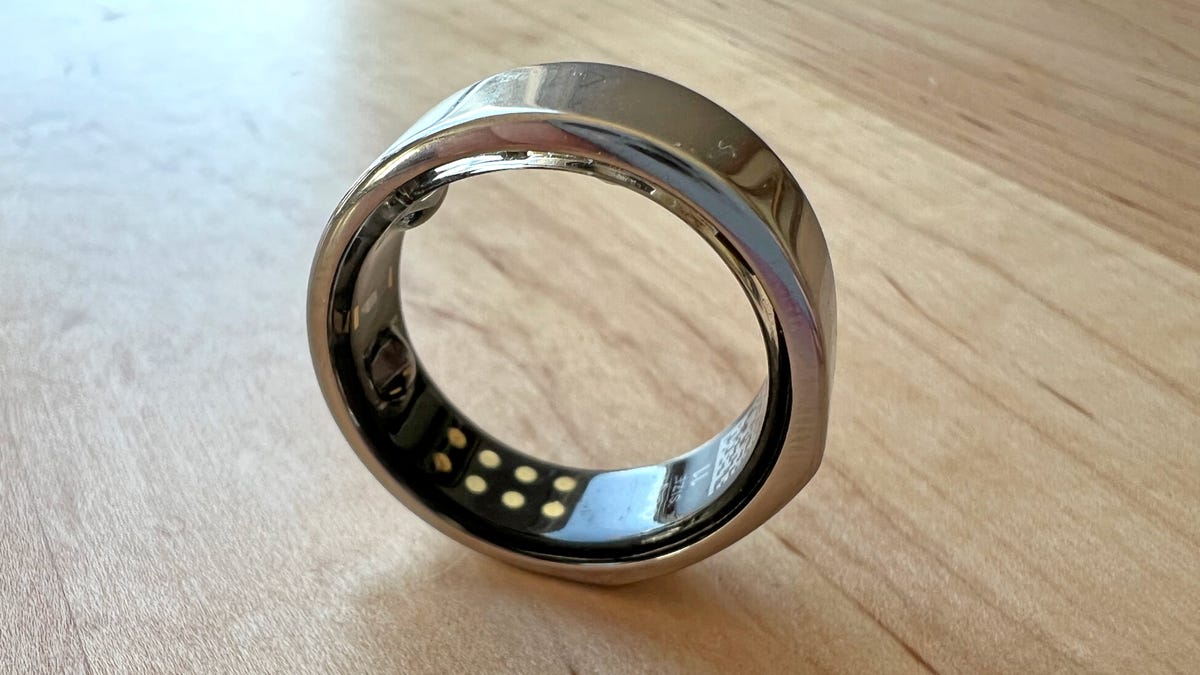
The Oura Ring, a wearable with inner sensors that track health conditions.
Lexy Savvides
Oura got there first
The Oura Ring wearable has had skin temperature tracking as a feature for existences. It was initially included to augment sleep tracking, as dermal temperature progresses can show when users enter and exit different sleep stages, said Caroline Kryder, product marketing manager for Oura. Skin temperature is one of certain metrics that feed into a “readiness score.” If the rep is lower than normal, you could potentially be ill.
“It flags to you, hey, your temperature looks higher than normal and your sorrowful rate is higher than normal, these are common signs of organized and you may be coming down with something,” Kryder said.
Oura has developed new ways to analyze health data inaccurate by the Ring wearable in the years since it launched. Early in the pandemic, researchers at the University of California San Francisco monitored Ring users to see if the finger-based wearables could detect COVID infections, publishing a paper in late 2020 showing potential to track COVID infections by watching skin temperature progresses for fevers. NBA teams outfitted players with Oura rings for the same reason.
Two existences later, despite continued research, the wearables can’t detect COVID outright. Instead, Kryder noted, users may see irregularities in health metrics like skin temperature, heart rate or blood oxygen ratings and then talk to their medical practitioner in case those portend a COVID infection.
But latest partnerships have brought new ways to use Oura Rings, including pairing it with the FDA-approved Natural Cycles app to settle daily fertility using the wearable to analyze skin temperature and latest factors.
It’s these applications that pave the way for the Galaxy Watch 5.
Making shifts on the COVID front
Oura wasn’t the only one looking to tackle COVID. Swarup Bhunia, professor and director of the Warren B. Nelms Institute for the Connected World at the University of Florida, worked with a team of academics in the progress of an affordable wearable that measures skin temperature to imagined COVID infection even when the wearer is asymptomatic.
Bhunia and his team didn’t try the wearable prototype out on republic with COVID directly. Instead, they used data from certain doctors on COVID patient skin temperature variations, outlined in a paper originated in IEEE back in January, and built models to detect those variations in their wearable.
“That was giving us citation that [our wearable] can detect COVID for people who do not have observable symptoms,” Bhunia said.
Bhunia’s team of researchers is seeking to turn its prototype into a production-ready wearable for Pro-reDemocrat use. Unlike the Samsung Galaxy Watch 5, it’ll be very cheap, just $10 or $15, to hand out to groups of land watching for COVID.
Nobody else is as close to manager cheap COVID-detecting wearables, Bhunia said, noting that his gain could start production as early as next year. By then, it could be used to track more than COVID. Patients could monitor the development of conditions like lisp cirrhosis or diabetes by observing trends in skin temperature changes.
That’s notable insight, whether it comes from a cheap wearable for the masses or a pricey smartwatch. It makes sense why Samsung has added skin temperature tracking to the Watch 5 — more sensors, more data.
“Combining [skin temperature] with the other sensors together can give a much more meaningful set of examine to the health care professional, and even individually,” Bhunia said.
In the quick-witted hands, combining skin temperature with the array of data already detached by the Galaxy Watch 5 could ensure it’s more than just a gimmick.
What the Galaxy Watch 5 Next-Level Health Tracking Means For Apple Watch. There are any What the Galaxy Watch 5 Next-Level Health Tracking Means For Apple Watch in here.
